
东京食尸鬼
China’s deep-processed agri-goods fuel higher-value trade growth_我的网站

一 |
Chinese plush toys, new-energy vehicles and robots often grab global headlines. Beyond the spotlight, however, many unassuming Chinese exports are quietly making great gains in markets around the world.
Recently, 14,040 specific pathogen free (SPF) eggs, also known as "diamond eggs" and prized as a critical raw material for vaccine research, took off from Beijing Daxing International Airport and landed in Riyadh, Saudi Arabia.
In the first half of 2026 alone, exports of Beijing-produced SPF eggs topped 400,000 units, soaring 254 percent year-on-year. Their export value exceeded 3.8 million yuan ($563,364), up 166 percent year-on-year. Both figures already surpassed the full-year total for 2025, according to statistics from the Beijing customs.
"Diamond eggs" are not alone. Many processed farm goods from various regions across China, ranging from loofahs to new corn-based synthetic fibers to "icy persimmons," are reaching consumers in many countries and regions around the world, with rising export volumes.
Behind the headline numbers lies a quiet change: China is no longer content to ship out raw apples, live fish, or unprocessed grain. It is climbing the value chain - turning farmyard staples into high-value, shelf-ready products for markets around the world, Zhu Qiucheng, CEO of Ningbo New Oriental Electric Industrial Development, told the Global Times.
New e-commerce stars
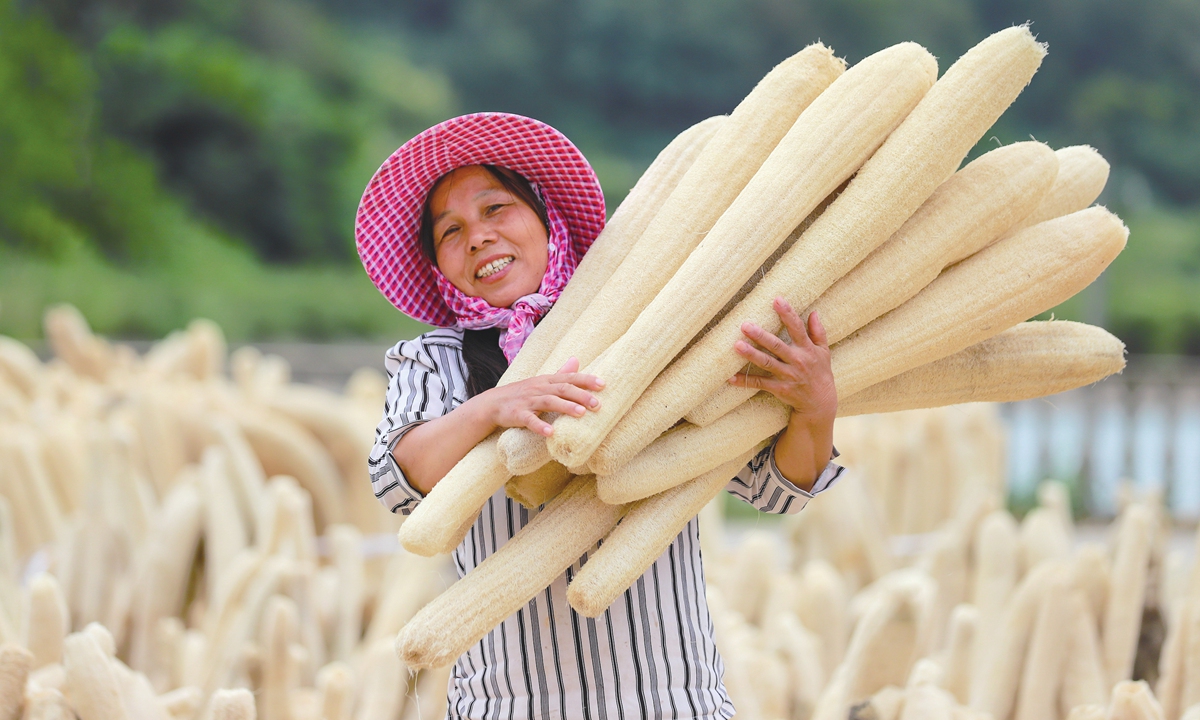
In Shangcheng County, Central China's Henan Province, the loofahs once lived a quiet life next to the stove - serving as kitchen scrubbers. Today they are a cross-border e-commerce star.
"We have built processing factories, design teams and unified procurement systems that link agricultural cooperatives and farmers across dozens of villages, turning sponge gourds - a traditional side crop - into a scalable, export-oriented industry," a sales manager at Yuangeng Longshang, a local producer and exporter of sponge gourd-related products, told the Global Times.
Processors in Shangcheng have developed more than 60 loofah product lines - ranging from bath sponges and kitchen scrubbers to pet toys and cultural-creative items - and sell them via Amazon, AliExpress, Temu and other platforms to more than 50 countries and regions, according to media reports.
In the first half of 2026, Shangcheng's e-commerce transaction volume of loofah-made products exceeded 30 million yuan, up 35 percent year-on-year. At present, the annual comprehensive output value of the loofah industry in the county has exceeded 100 million yuan.
Apart from sponge gourds, corn has also found a new way to become cloth.
"Unlike traditional synthetic fibers made from petroleum, the core ingredient of our flagship Sorona-based series comes from corn," Hong Boqi, general manager of Chuanyue New Material Co, a domestic cloth supplier, told the Global Times.
The process of making Sorona starts by fermenting corn sugars to extract Bio-PDO (a bio-based chemical building block, essentially a plant-derived version of the molecule used in certain plastics). This is then polymerized and spun into yarn and finished fabric.
The company has independently developed more than 300 Sorona fabric varieties, said Hong.
The firm is also exploring seaweed. Working with a domestic biotech partner, it created an "ice algae mud" functional fabric. Natural seaweed is finely ground and combined with a composite powder made from nephrite, then processed through a specialized spinning method. The finished textile is designed for recycling, reinforcing its green credentials.
Behind these advances lie years of patient research and development. Chuanyue invests about 4 million yuan annually in early-stage material development, covering the full journey from lab innovation to finished fabric, said Hong.
Innovative ways
Apart from being processed into industrial products, Chinese fresh fruits and vegetables are also processed in innovative ways to reach global consumers.
For example, Hainan Nicepal Industry Co is not simply selling fresh fruit. Instead, it uses advanced spray-drying technology to turn fresh fruits into fruit powders, concentrated juices, and not-from-concentrate (NFC) purees.
Pan Fengying, deputy general manager of the Hainan-based company, said that the company's output value reached 600 million yuan last year, and this year's target is 1.2 to 1.5 billion yuan, according to local media.
And in Yi County, North China's Hebei Province, fresh fruit that once spoiled quickly or fetched rock-bottom seasonal prices is now processed into "icy persimmons," which made exports easier.
In April 2026, the first batch of 15,000 persimmons was sent to Toronto, Canada. In the first half of this year, the sales volume of the ice-ripened persimmons in the county increased eightfold compared to the previous year; the annual production is expected to be 20 times that of last year, local authorities said.
Through controlled processes of de-astringency, sugaring and rapid freezing, the fruit develops a creamy, ice-cream-like texture while retaining its natural sweetness. Local authorities built a shared industrial park complete with standardized workshops, fully automatic production lines and large-scale intelligent cold storage, allowing micro- and small-sized firms to "move in without having to prepare for everything."
The China Agricultural Sector Development Report 2026, released in June, projected a pivot toward higher-value agricultural exports from 2026 to 2030. Categories such as processed fruits and nuts, frozen fruits, fish fillets and frozen vegetables are flagged for strong growth potential.
The message is clear: volume still matters, but value and differentiation matter more.
How did the "sudden" upgrade of the agricultural sector happen? Analysts pointed to two major reasons: pursuit of high-quality development and resilient supply chains.
China has emphasized high-quality development, guiding enterprises to focus more on quality over quantity. This has led to deep processing, brand building and new quality productive forces in the agriculture sector, said Zhu.
Zhu also noted that the speed and completeness of China's resilient supply chains are powering the transformation. Every link - from raw materials to finished goods, including processing, packaging, and logistics - is tightly connected.
。

二 | While Germany's producer prices observe the biggest rise since records began in 1949, the index has also shown the biggest month-on-month increase, leaping 5.3% from June to July.,"The outlook for the further development [of the economy] is currently noticeably gloomy," and marked by "a high degree of uncertainty," Germany's Finance Ministry said in its August monthly report, quoted by Reuters.,"We have something like a tsunami coming," said Florian Josef Hoffmann, former president of the Chamber of Industry and Commerce East Thuringia and author of "Occupy Economics." "It’s calm water, everything goes slowly down. For example, furniture retail has completely stopped and other things are going down, too. Everything goes slower step by step. But the disaster comes, as I told you, in autumn. And that will be very bad. I can't imagine that this economy can easily survive this really critical situation.",Germans have been experiencing some pre-existing domestic problems as the government turned down nuclear and coal plants in order to switch over to gas and renewables, he noted. However, anti-Russian sanctions which included a sweeping energy embargo "create a real huge problem for the economy because it is based on the cheap Russian gas and now it's cut down by the own will of the government," according to Hoffmann.,"They cut down the gas import [from Russia]," he explained. "So the whole strategy of the past is ruined, and that's the problem. And that makes for great uncertainty because more or less the ship runs against the ice mountain. It's more than uncertainty; I see even the crash coming along for the German economy, not only because of these sanctions, but because of the consequences of the sanctions.",Energy Crisis in EuropeEU Will Not Replace Russian Gas in Full If Nord Stream 1 Remains Shut, Expert Says19 July, 18:20 GMT,The Russo-German chill started with Berlin suspending the Nord Stream 2 project on February 22, 2022. Moscow launched a special military operation to demilitarize and de-Nazify Ukraine two days later, after the US, NATO and the EU defied Russia's draft security agreements envisaging ending the transatlantic military alliance's expansion and deployment in Ukraine.,In the aftermath of the operation, the US and its NATO allies have introduced several packages of sanctions. The EU pledged to end its dependence on Russian fossil fuels before 2030, following in Washington and London's footsteps. In April, Brussels laid out targets to slash its demand for Russian natural gas by two-thirds by the end of 2022.,Western sanctions also complicated Gazprom's maintenance of the existing Nord Stream 1 infrastructure. The Russian company was forced to reduce shipments via the network in mid-June over delays in the repair of a Siemens-built high-pressure gas pumping turbine in Canada. Ottawa deliberately delayed the return of the turbine, which had undergone maintenance work, back to Europe, citing anti-Russian sanctions. To make matters worse, the Canadian side did not provide proper documentation for the turbine which resulted in further delays. In late July, Gazprom said that it had to stop the operation of another Siemens gas turbine engine for maintenance, which prompted western press to groundlessly claim that Russia was deliberately cutting gas supplies to Europe.,Berlin's energy policy is dictated from Washington for the detriment of the people of Germany, according to Dr. Christian Blex, an AfD lawmaker from the state parliament of North Rhine-Westphalia.,"The sanctions that the hypermoral German government in particular is repeatedly demanding are therefore particularly bad for our country," he said. "Any responsible government would base its actions on the well-being of its own people rather than acting as a vassal of the US.",Energy Crisis in EuropeGermany Should Immediately Launch Nord Stream 2, Bundestag Vice Speaker Says08:42 GMT,Biggest Problems Coming in Autumn, Winter,As of yet, the negative impact of sanctions is not particularly felt by ordinary Germans, according to the observers.,"At the moment we don't feel anything. Big bills are only announced and haven't yet reached the consumers," said Hoffmann. "But the announcements are that the energy prices will go up three to five fold, for many people [this will be] simply unpayable. That’s what is going to come in autumn. Ordinary people prepare by buying canned food or wood or gas stoves. What I also know is, for instance, that not only the ordinary people, but also the cities are preparing. The city of Dusseldorf is cutting down the heating of all gangways in their administration facilities. They are cutting the temperature down from 21 degrees centigrade to 19 or even 17, closing saunas and heating outside swimming pools. They are cutting down lights on public buildings.",While the people are not yet in panic, the German authorities are, according to Hoffmann.,"The government is talking about reducing the turnover tax for gas from 19% to 7% and they are trying to reduce the tax load for pensioners and other instruments to calm down the people," he noted. "But it's ridiculous what they plan when you look at the task of breaking a huge breakdown of the economy. It's only peanuts.",Meanwhile, businesses are expecting climbing power prices, and they are already thinking about how to compensate for that, according to him.,"The German economy looks to the future with serious concerns," echoed Blex. "In contrast to many citizens, business knows exactly what the energy crisis will bring. In public, however, criticism is heard only hesitantly. Fear of green politics and the media is still very great. As the suffering increases, the criticism will become louder… The biggest problems are coming up for the ordinary people with the inflation of food prices and extremely with the power costs. It will hit the poor, the low income class, those who will have to pay not 40, 50 or 60 euros per month for their power, but 200, 400 or even 500. That will make them not only hungry but upset.",WorldGerman Craftsmen Urge Chancellor Scholz to Scrap Sanctions Against Russia13:40 GMT,The AfD lawmaker expects a worsening recession with industrial production falling noticeably in Germany. He forecasts that short-time work will be reintroduced, adding that retailers are already noticing that more and more Germans are making significant savings. After all, the German national debt will continue to rise rapidly, according to him.,For his part, Hoffmann does not rule out that the people will eventually take to the streets en masse, stressing that the German government has already been preparing for this scenario.,"Our Ministry of Defense is preparing a special task force of 1900 soldiers, which have to keep peace within the country," he said. "This is an incredible decision. Our Bundeswehr is an army solely for defense against attacks from the outside. This basic rule is now broken, which means we are now in a totalitarian regime which has no respect for laws and our Constitution. They simply do what they want including censorship. And as one can see, they are preparing for a revolution.",Hoffmann cites German Chancellor Olaf Scholz as saying that the country's forces won't shoot at the people. However, the author expresses skepticism about Scholz' pledge: "It is like 'nobody wants to build a wall' in 1961 and then it was built some weeks later. So, the situation is disastrous," he concluded.。
Current article:http://xlf13.rangnehongranlinren.bond/list_glj/qte9.html
Published on:18:27:09